
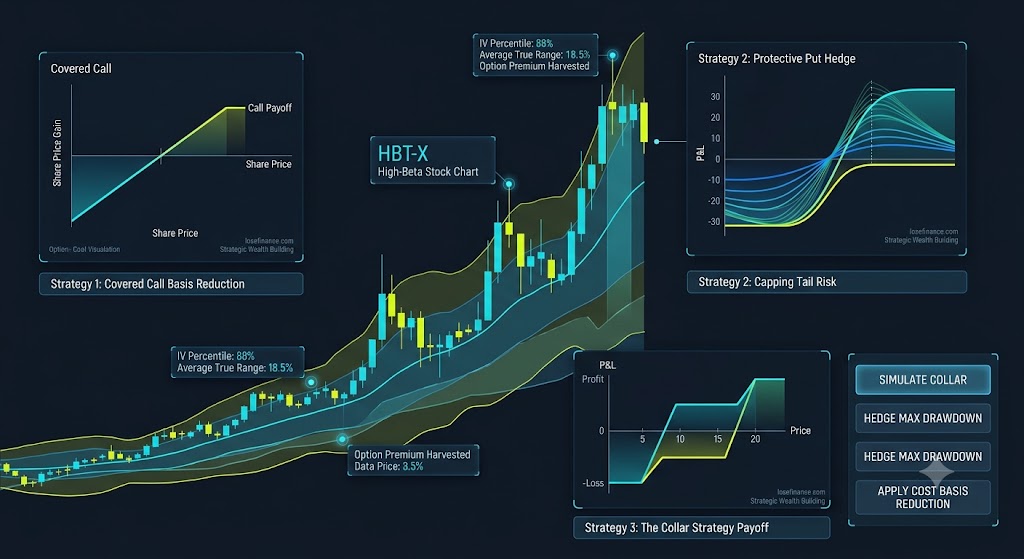
Investing in high-beta technology sectors or cryptocurrency proxies—such as Coinbase leveraged vehicles (e.g., CONL) or micro-cap AI scaling plays—presents an exhilarating growth path. However, the staggering 15% to 20% single-day drawdowns common to these assets can test the resolve of even the most bullish investors. Many retail traders adopt a passive “wait until I break even to exit” mentality, which often results in dead capital trapped during multi-month consolidations.
Professional institutional managers rarely expose themselves to naked down-side risk. Instead, they transform linear volatility into asymmetric, protected positions using derivatives.
For intermediate to advanced traders, here is the institutional playbook on how to utilize equity options to hedge downside risk, amplify capital efficiency, and accelerate your break-even timelines.
1. The Covered Call: An Accelerator for Stranded Capital
When a high-beta stock suffers a deep correction, many investors simply hold and hope. A far more strategic alternative is harvesting the asset’s elevated Implied Volatility (IV) by executing a Covered Call strategy.
High-beta equities command massive option premiums because the market prices in extreme implied movement. By selling an “Out-of-the-Money” (OTM) Call option against your existing 100 shares, you immediately collect cash upfront (the option premium).
- The Logic: If your primary goal is to liquidate the position upon recovering your initial capital, you can set the call option’s strike price exactly at your break-even point.
- The Benefit: If the stock consolidates or recovers slowly, the premium you harvest directly lowers your effective cost basis. It essentially acts as a recurring dividend, allowing you to “break even” and exit the position much faster than someone just holding raw equity.
2. Protective Puts: Capping the Tail Risk
Before major macro catalysts—such as Federal Reserve rate decisions, CPI prints, or highly anticipated tech earnings—high-beta stocks become incredibly vulnerable to gap-downs. To insulate a high-conviction portfolio from black-swan events, sophisticated traders employ Protective Puts.
By purchasing a “slightly out-of-the-money” Put option, you establish a hard floor under your equity value.
Think of this as an insurance policy. If a market correction triggers a 30% collapse in the underlying stock, the value of your Put option will surge exponentially, offsetting the physical losses of your equity position. Your maximum loss is strictly capped at the strike price minus the premium paid, ensuring you survive systemic liquidation events with your capital intact.
3. Mitigating the Lethal Friction of Leverage Decay
Many retail market participants turn to leveraged exchange-traded products (like 2x or 3x long ETFs) to maximize their upside momentum. While highly effective for short-term day trading, holding these instruments long-term during a choppy, sideways market introduces a hidden mathematical trap: Volatility Drag (Leverage Decay).
Because leveraged ETFs reset their performance metrics on a daily basis, a volatile asset that constantly moves up and down without a clear trend will naturally erode its net asset value (NAV).
To avoid this systemic erosion, professional traders simulate leverage using options instead of holding daily resetting decay products. By utilizing long-term equity anticipation securities (LEAPS) or constructing defined-risk vertical spreads, you can capture explosive geometric upside without suffering the daily mathematical decay inherent to leveraged ETFs.
The Bottom Line
The financial markets do not reward reckless exposure; they reward structure. High volatility should not be feared—it should be harnessed. By shifting your approach from simple spot equity exposure to structured option mechanics, you gain the ability to generate predictable income during sideways churn and insure your balance sheet against catastrophic drawdowns.
Stop letting volatility manage you. Implement structural hedging, take control of your cost basis, and turn market turbulence into your primary mathematical advantage.
Disclaimer: The information provided in this article is for informational and educational purposes only and does not constitute financial, investment, or legal advice. Options trading involves high leverage and high risk, and is not suitable for all investors. Always conduct your own research before executing derivative strategies.



Leave a Reply